
There is a story every Japanese child knows by heart, and almost no one outside Japan has read.
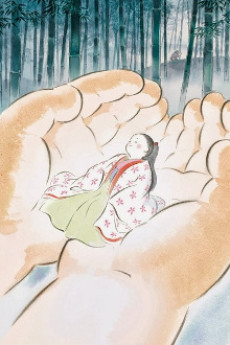
An old bamboo cutter finds a glowing stalk. Inside is a girl the size of a thumb. He raises her, she grows into the most beautiful woman in the country, and noblemen line up to marry her. She refuses them all by setting five impossible quests. Even the Emperor is turned down. And then, on a full-moon night in August, she tells her adoptive parents the truth: she was never from here. She is from the Moon, and they are coming to take her back.
That's 竹取物語 (Taketori Monogatari), The Tale of the Bamboo Cutter — written sometime between the late 9th and early 10th century. It is the oldest surviving work of Japanese prose fiction, and The Tale of Genji itself calls it "the ancestor of all tales."
Eleven hundred years later, it is still running through anime — sometimes as a faithful adaptation, sometimes as a character's name, sometimes as a shape a story falls into without ever mentioning bamboo. Netflix put a new version of it in front of a global audience this year. Here's the original, and everywhere it's hiding.
The story itself
Worth knowing properly, because the details matter later:
The finding. A bamboo cutter sees a stalk shining in the grove. Inside is a girl about three sun tall — roughly nine centimetres. He takes her home. From then on, every bamboo stalk he cuts is full of gold, and the family becomes wealthy.
The growing. She reaches adulthood in about three months. She is named Kaguya-hime, "shining princess," and word of her beauty spreads until suitors camp outside the house.
The five impossible tasks. Kaguya-hime doesn't reject the five persistent nobles outright. She names a treasure each must bring her:
- the stone begging bowl of the Buddha — said to exist only in India
- the jewelled branch from Mount Hōrai — silver roots, golden stem, pearls for fruit
- the robe of the fire-rat, which cannot burn
- the jewel from a dragon's neck
- the cowrie shell born of a swallow
Every one of them fails, and the failures are the funniest part of the original: one buys a fake and gets caught when the craftsmen show up demanding payment, one nearly dies at sea and blames Kaguya-hime for it, one falls from a height grabbing at a swallow's nest.
The Emperor. Even he is refused — though the two exchange poems for three years, which is the closest the story comes to a love story.
The departure. On the fifteenth night of the eighth month, celestial beings descend. Guards are posted; they are useless. Kaguya-hime is given a robe of feathers that erases all earthly memory and feeling, and she goes.
The ending nobody expects. She leaves the Emperor an elixir of immortality. He refuses to drink it — what use is eternal life without her? — and orders it burned on the mountain closest to Heaven. That mountain is Mount Fuji, and the tale offers this as the origin of its name: 不死, fushi, "immortality."
Japan's first story ends with someone throwing away eternal life because it isn't worth having alone. That's the tone the rest of this article keeps circling back to.
The direct retellings
Cosmic Princess Kaguya! (2026)

The newest and the reason a lot of overseas viewers are meeting this story for the first time. Cosmic Princess Kaguya! is a Studio Colorido × Studio Chromato film that relocates the tale to Tsukuyomi, a virtual world, and runs it through modern music and animation. Its own synopsis calls it a reimagining of "Japan's oldest folktale."
It landed well: on AniList it holds a score of 84 with an unusually high favourite rate — about 7% of the people who logged it also favourited it, higher than Kaguya-sama (5.4%) or Dan Da Dan (5.0%). Not a mega-hit by member count, but the people who watched it cared. Netflix carrying it globally is why.
The Tale of the Princess Kaguya (2013)
The other one, and a completely separate film — worth stressing, because sharing a princess doesn't make them the same work. Isao Takahata's The Tale of the Princess Kaguya is Studio Ghibli's adaptation, drawn in charcoal-and-watercolour lines that look like a scroll painting come alive, and it is the closest thing to a definitive version.
Takahata's reading is the bleak one. His Kaguya-hime isn't a mysterious visitor — she's a girl who loved the hills and the seasons and was steadily crushed into a noblewoman's life she never asked for. The five suitors aren't comic relief; they're men describing her as a treasure to be acquired. And the ending, with the celestial procession arriving to cheerful music while she's dragged from everything she loved, is one of the most devastating sequences in animation.
Same source, opposite emotional temperature. Watch both if you want to see how far one folktale stretches.
The ones wearing it as a name
Kaguya-sama: Love is War

This is the connection most Western fans miss entirely, and it's not decoration — the premise is the folktale.
Kaguya Shinomiya is named for the princess. And the entire show runs on the same engine as the five impossible tasks: a woman of impossibly high status who will not simply say she's interested, and who instead constructs elaborate trials that the suitor must pass. Every episode of Kaguya-sama is a smaller version of "bring me the jewel from a dragon's neck."
The original ends with Kaguya-hime leaving Earth without ever having loved anyone. The anime is, in a very real sense, an 1,100-year-later rewrite where she's allowed to lose the game and stay — which is exactly what Ultra Romantic builds to.
If you want the mechanics of why neither of them can just say it, we wrote about the confession as a formal, answerable act.
Naruto — Kaguya Ōtsutsuki

Naruto's final antagonist is named Kaguya, arrived from beyond the world, is tied to the Moon, and her story begins with a divine tree. English-speaking fans often read her as a generic final boss appearing from nowhere. Japanese viewers heard the name and immediately knew the register being invoked: the celestial woman who does not belong to Earth and whose arrival ends things.
The Moon in Naruto isn't set dressing either — it's a prison, a destination, and a source of power, which is a very old set of associations in Japanese storytelling.
Sailor Moon, and everyone else
Sailor Moon S: Hearts in Ice builds its plot around a villain named Kaguya and a princess from the Moon — a franchise whose entire premise is already a moon kingdom in exile. InuYasha has its own Kaguya. Once you start noticing, the name turns up constantly, and it always signals the same thing: beauty, distance, and something not human.
The shape underneath: the visitor who has to leave
Here's the part that outlives the plot.
Strip Taketori Monogatari down and you get: someone arrives from elsewhere, is loved, and must go back. No villain. No mistake to correct. The separation is structural — it was always going to happen, and knowing that in advance is precisely what hurts.
That shape is everywhere in anime, in stories that have nothing to do with bamboo:
- Anohana — a friend returns for one summer and has to be sent off properly.
- Into the Forest of Fireflies' Light — a boy who cannot be touched and will not be there next summer.
- Clannad: After Story — the whole back half.
- 5 Centimeters per Second — no supernatural element at all, same ache.
And if you've read our piece on Obon, you'll recognize the emotional grammar: a festival where the dead come home for three days and are then sent back. Japan has a thousand-year habit of building its best stories around a farewell that everyone can see coming.
Western storytelling tends to treat separation as a problem to be solved — the lovers find a way, the door opens again. Kaguya-hime doesn't get that. She's given a robe that erases her memory of Earth, and she goes. The people who raised her are left standing in a field looking up.
That's not a sad ending badly handled. That's mono no aware — the ache in the fact that things end — installed at the very foundation of Japanese fiction, in the first story anyone bothered to write down.
Where to start
- The faithful, devastating version — The Tale of the Princess Kaguya
- The modern reimagining — Cosmic Princess Kaguya! (Netflix)
- The comedy that's secretly the same structure — Kaguya-sama: Love is War
- The shape without the folktale — Anohana, Into the Forest of Fireflies' Light
Japan's first story is about a girl who was never going to be able to stay. Eleven centuries later, an industry is still working through it.
More culture explainers on AnimeBuzz: Obon and the festival of the dead, the kokuhaku confession, the bukatsu club system. Or browse the data: all-time rankings, by genre, by tag.
Sources and notes
- 竹取物語 (Wikipedia) — dating (late 9th–early 10th century), the Genji reference calling it the ancestor of all tales, plot summary and the Mount Fuji etymology
- 竹取物語の五つの難題(扶桑) and かぐや姫「5人の貴公子」の名前一覧と難題の内容 — the five treasures and which suitor received which
Popularity figures for Cosmic Princess Kaguya! are from AniList community data as tracked by AnimeBuzz at the time of writing.