
Put on almost any anime set in July and turn the volume up. Underneath the dialogue there is a solid, unbroken sheet of noise — a rasping, mechanical, faintly electrical roar that never lets up.
That's cicadas. Japanese studios lay them under summer scenes the way Western films lay strings under a sad one.
And here's the thing: for a large share of the audience, that sound carries no information at all. It registers as static. Which means a piece of the storytelling — sometimes the piece that tells you the whole scene is about loss — passes straight through without landing.
Here's what's actually in it.
Britain has no cicadas

Not "few." Effectively none.
The New Forest cicada (Cicadetta montana) is the only cicada native to the British Isles, confined to a patch of Hampshire heathland. It has not been reliably recorded since around the turn of the millennium and is widely feared extinct there. Its call is also pitched so high that many adults physically cannot hear it.
So a British viewer watching a Japanese summer scene is hearing a sound with no referent whatsoever. Not "a sound that means something different" — a sound they have never encountered outside of anime.
North America is a different case, and worth separating out. The US has annual "dog-day" cicadas every summer, plus the famous periodical cicadas that emerge in 13- and 17-year broods. But the cultural frame around them is a spectacle or an infestation — a news event, something to photograph or complain about. It is not a seasonal marker that sits quietly under everyday life.
In Japan it's a calendar. Different species peak at different points, and their overlapping calls tell you roughly where you are in the summer. Studios use this deliberately. The cicada track is a timestamp.
Japan turned insects into music
This is not a recent aesthetic. It's about a thousand years old.
Around the year 1000, Sei Shōnagon opened a section of The Pillow Book by simply listing insects worth hearing, starting with the bell cricket. Not insects worth eating, avoiding, or farming. Worth listening to, ranked by preference, the way you'd rank composers.
By the Heian period, aristocrats held 虫聞き (mushi-kiki) — insect-listening excursions. You went out to a known good spot in the evening, in autumn, specifically to sit and listen to crickets. It was an occasion, with the same status as viewing cherry blossoms or the moon.
By the Edo period it had gone commercial. 虫売り (mushi-uri), insect sellers, worked the streets of Edo with stacked bamboo cages, selling live singing insects to ordinary households. You bought an insect the way you'd buy a record: for its voice.
The two stars were the suzumushi (鈴虫, "bell cricket"), which produces a high silvery rin-rin that genuinely does sound like a small bell, and the matsumushi (松虫, "pine cricket"). Both have names, both have described calls, both appear in poetry. They are individuated the way birds are in English.
That is the actual difference. Not perception — vocabulary and attention. English has one word, "chirping," for the entire order. Japanese has named species, verbs for their singing, and a thousand-year critical tradition about which ones sound best.
About that "Japanese brain" claim
You will run into this one, so it's worth handling directly.
In 1978 the physician Tadanobu Tsunoda published Nihonjin no Nō ("The Japanese Brain"), arguing that Japanese speakers process insect sounds in the left hemisphere — the language side — while Westerners process them in the right, alongside music and noise. The popular version: Japanese people hear insects as voices, foreigners hear them as sound.
It is enormously well known in Japan and gets repeated constantly.
It has not held up. The work was never successfully replicated outside Tsunoda's own lab, the methodology has been heavily criticised, and it is not accepted in mainstream neuroscience. It also slots neatly into nihonjinron — the genre of writing that explains Japan by asserting that Japanese people are built differently — which is reason enough to handle it carefully.
The cultural difference is real and observable. The neurological explanation for it is not. You don't need one: a culture that names insects, sells them for their voices, and has ranked their calls since the Heian period will notice them. A culture that lumps them all under "bugs" will not. Attention is learned.
Higurashi: the cicada that means it's over

Now the specific one.
Among the summer cicadas, one is used as a device: the higurashi (ヒグラシ, Tanna japonensis), the evening cicada. Its call is written kana-kana-kana — clear, descending, echoing, nothing like the flat drone of the others.
Three things make it special.
It sings at the edges of the day. Higurashi are crepuscular, calling most at dusk and dawn. So the sound arrives with fading light.
It reads as the end of summer. Higurashi actually start in July, but the association is with summer running out. In haiku, ordinary cicadas are a summer kigo (seasonal word) — but higurashi is classified as autumn. The insect is physically a summer creature that the poetic tradition files under the following season. That tells you exactly what it's for.
It is unambiguously melancholy. Not neutral, not pleasant. It carries the specific feeling of something ending while you're still inside it.
This is why the horror series When They Cry is called Higurashi no Naku Koro ni — "when the higurashi cry." The title is a time stamp and a mood in one, and every Japanese viewer gets both instantly. The English title drops the insect entirely, and with it the whole seasonal frame.
Once you know the sound, you'll catch it doing work all over the place: in Natsume's Book of Friends, in Anohana, in Non Non Biyori. When the flat drone drops out and a single descending kana-kana comes in over a still shot, the scene has just told you the summer is ending — and usually that something else is too.
The wind chime rings because there is wind
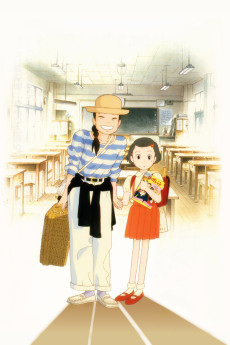
The other sound is the furin (風鈴), the glass wind chime hung under the eaves.
Japanese viewers consistently describe it as cooling. That's worth unpacking, because a wind chime is obviously not a refrigeration device.
It started as religion, not decoration. Bronze bells called 風鐸 (fūtaku) were hung at the corners of pagoda and temple-hall eaves, imported with Buddhism from China. The belief was that the area the sound reached was protected — the ringing marked out a zone that misfortune couldn't enter. The chime was a boundary you could hear.
Glass furin arrived in the Edo period, when imported glassblowing made them possible. They were luxury goods at first, then spread. Today the two famous types are Edo furin (hand-blown glass, painted from the inside so the design doesn't wear off) and Nanbu furin (cast iron from Iwate, with a longer, purer tone).
As for why it feels cold: the honest explanation is that the sound is evidence. A furin only rings when air is actually moving. In a Japanese summer — humid, still, oppressive — a breeze is the single most desirable thing in the environment, and the chime is an audible proof that one exists. Hear the chime, and you know, without looking up, that air is moving across the room.
Add several generations of association with summer evenings, cold barley tea and open sliding doors, and the response becomes automatic. It isn't temperature. It's a learned promise.
What to listen for
Next time, treat the sound design as text rather than atmosphere:
- Flat, unbroken drone, midday, bright — high summer, nothing wrong, often used to make heat feel oppressive and time feel stuck. Summer Wars, My Neighbor Totoro, Barakamon.
- A single descending call at dusk — higurashi. Something is ending. When They Cry, Anohana, Into the Forest of Fireflies' Light.
- Silvery pulsing at night, indoors or in grass — bell crickets. Autumn has arrived. The register is quieter and more delicate than the cicadas, and the shift between them is a scene transition in itself. Mushi-Shi, Only Yesterday.
- A single glass chime over a still interior — a breeze, a moment of relief, usually a beat of calm before or after something. Whisper of the Heart, Hyouka, The Garden of Words.
- Cicadas cutting out abruptly — an editing move. Sudden silence in a summer scene reads as wrong to a Japanese ear, because that sheet of sound is supposed to be constant. Grave of the Fireflies uses the absence as much as the presence.
The point
Japanese summer scenes aren't quiet, and they aren't scored the way Western ones are. They're carrying a second layer of information in the ambience — which week of the season it is, whether the light is going, whether the air is moving, whether this is a beginning or an ending.
If cicadas have never meant anything to you, that layer has been running silently under everything you've watched. It's not that you missed a detail. You've been missing a channel.
More culture explainers on AnimeBuzz: Noh and Zeami, Japan's oldest story, the school festival system, the kokuhaku confession. Or browse the data: all-time rankings, by tag.
Sources and notes
- ヒグラシ (Wikipedia) — Tanna japonensis, the crepuscular calling pattern, and its classification as an autumn kigo despite being a summer insect
- スズミムシ/鈴虫 (Wikipedia) and 虫聞き (Wikipedia) — the bell cricket, Heian insect-listening excursions, and the Edo insect trade
- 風鈴 (Wikipedia) — the fūtaku origin, the Edo-period shift to glass, and the Edo/Nanbu types
- New Forest cicada (Wikipedia) — Britain's only native cicada, its restricted range and its status
- 角田忠信 (Wikipedia) — Nihonjin no Nō (1978) and the criticism of it. The hemisphere claim is presented here as a well-known hypothesis, not as established science; it has not been independently replicated
- 『枕草子』 (The Pillow Book, c.1002), the section listing insects — the earliest well-known ranking of insects by the quality of their song